
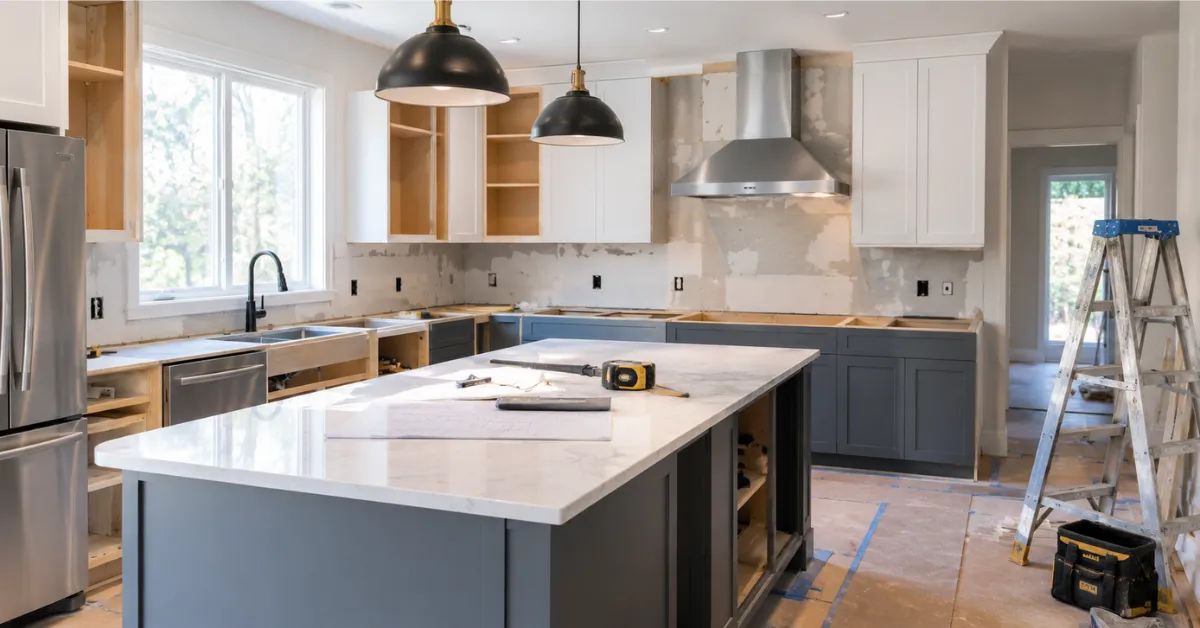
A kitchen remodel can cost anywhere from about $10,000 for a modest refresh to well over $100,000 for a large, high-end transformation. For a typical U.S. kitchen remodel, current 2027 cost data from Angi puts the national average at about $26,945, with most projects falling between $14,589 and $41,559. The actual cost of remodeling a kitchen depends heavily on the size of the room, cabinet choices, appliances, countertops, labor, permits, and whether you keep the existing layout.
The biggest budgeting decision is usually not the size of the kitchen alone. It is how much of the kitchen you change. Keeping the existing plumbing, electrical locations, walls, and cabinet layout can make a substantial difference. Moving a sink, gas line, island, or wall can turn a relatively straightforward renovation into a much more involved project.
If you are trying to estimate your own kitchen remodel cost, start by deciding whether you need a cosmetic refresh, a functional remodel, or a complete redesign. Then price the major components separately instead of relying on one broad number.
Kitchen Remodel Cost at a Glance
Here is a useful starting point for understanding the different levels of remodeling:
| Remodel Type | Typical 2027 Cost Range | What It Usually Includes |
| Minor remodel | $10,000 to $20,000 | Paint, cabinet updates, hardware, limited fixture or appliance changes |
| Major remodel | $20,000 to $65,000 | Cabinets, countertops, appliances, flooring, lighting, and other substantial upgrades |
| Complete remodel | $65,000 to $130,000+ | Major layout changes, custom cabinetry, relocated utilities, premium materials and appliances |
These ranges are based on current Angi cost data and are intended as broad planning ranges rather than quotes for a particular home. Location, kitchen size, labor rates, materials, and project complexity can move the final price significantly.
A small kitchen does not automatically mean a cheap remodel. Some costs, such as design, demolition, permits, electrical work, plumbing, and contractor labor, do not decrease proportionally with square footage.
How Much Is It to Remodel a Kitchen?
For homeowners asking, “how much is it to remodel a kitchen?” the most useful answer is that there is no single price that fits every project.
A simple kitchen refresh may stay near the lower end of the range if you keep the existing cabinets, appliances, plumbing, and layout. A larger renovation can climb quickly when you replace cabinets, add an island, upgrade appliances, install new flooring, change lighting, and move plumbing or electrical connections.
Angi’s 2027 data places the average professional kitchen remodel at approximately $26,945, with most homeowners spending between $14,589 and $41,559.
Another useful benchmark is cost per square foot. Current Angi data places kitchen remodeling at roughly $75 to $250 per square foot, although this figure should not be treated as a simple calculator that guarantees a final price. Smaller kitchens can have a higher effective cost per square foot because fixed expenses are spread across less space.
For example, a 100-square-foot kitchen and a 200-square-foot kitchen may both require permits, design work, demolition, delivery, and professional labor. The larger kitchen may need more materials, but the smaller kitchen does not eliminate those fixed project costs.
What Does a Kitchen Remodel Cost by Project Size?
Kitchen size matters, but it should be considered alongside the scope of work.
Small Kitchen Remodel
A small kitchen remodel can often focus on improving the appearance and function without changing the basic footprint. Current 2027 data from Angi places small kitchen remodels around $10,500 to $20,000 for kitchens in the 70 to 100 square foot range.
Common projects include:
- Refinishing or replacing cabinet fronts
- Installing new cabinet hardware
- Replacing countertops
- Adding a backsplash
- Updating a sink and faucet
- Painting walls
- Replacing selected appliances
- Improving lighting
- Updating flooring
Keeping the existing plumbing and electrical locations can help control the scope.
Major Kitchen Remodel
A major remodel can involve substantially more replacement work while still keeping the general room layout.
This might include new cabinets, countertops, flooring, appliances, lighting, a sink, faucet, backsplash, and an island. Angi currently places major kitchen remodels in a broad range of $20,000 to $65,000.
Material choices make a major difference within this category. Stock cabinets and standard finishes can produce a very different total from custom cabinetry, premium countertops, designer fixtures, and high-end appliances.
Complete Kitchen Remodel
A complete remodel is much more extensive. It can involve removing most existing finishes and changing the layout, walls, plumbing, electrical system, gas connections, cabinetry, appliances, flooring, and lighting.
Current Angi data puts complete kitchen remodels around $65,000 to $130,000 or more.
At this level, the cost is not simply about buying better-looking materials. The labor and infrastructure work can become a significant part of the budget.
Kitchen Remodel Cost Estimator: How to Build Your Own Budget
A kitchen remodel cost estimator is more useful when it breaks the project into individual components.
Instead of starting with one number, create a list like this:
| Cost Category | What to Include |
| Cabinets | Refacing, refinishing, stock, semi-custom, or custom cabinets |
| Countertops | Material, fabrication, edges, installation |
| Appliances | Refrigerator, range, dishwasher, microwave and other appliances |
| Flooring | Material, removal, preparation and installation |
| Plumbing | Sink, faucet, supply lines and fixture relocation |
| Electrical | Outlets, lighting, wiring and fixture changes |
| Walls | Paint, drywall repairs, tile or backsplash |
| Hardware | Knobs, pulls, hinges and other hardware |
| Demolition | Removal and disposal of old materials |
| Permits | Required local permits and related fees |
| Design | Designer or planning services when needed |
| Labor | Contractor and specialist labor |
| Contingency | Reserve for unexpected conditions |
This approach gives you more control because you can change one part of the project without rebuilding your entire budget.
For instance, if new custom cabinets push your budget too high, you can investigate cabinet refacing or semi-custom options without automatically eliminating the countertop or flooring upgrades you care about.
Kitchen Remodel Cost Calculator: A Simple Method
A kitchen remodel cost calculator does not need to be complicated.
Use this basic formula:
Total Remodel Budget = Materials + Labor + Design + Permits + Demolition + Delivery + Contingency
Then break materials into individual categories.
For a more detailed estimate:
Cabinets + Countertops + Appliances + Flooring + Lighting + Plumbing + Paint + Hardware + Other Materials + Labor + Fees = Estimated Project Cost
The advantage of this method is that you can identify the expensive parts before construction begins.
For example, if your budget is limited, you may decide to:
- Keep existing cabinets and replace only hardware
- Refinish cabinet doors instead of replacing the boxes
- Keep the existing appliance locations
- Choose a standard countertop material
- Paint instead of replacing some wall finishes
- Install new lighting without moving electrical locations
- Handle suitable cosmetic work yourself
The goal is not to make every category as inexpensive as possible. It is to spend more deliberately on the features that matter most to you.
What Is the Most Expensive Part of a Kitchen Remodel?
Cabinetry is often one of the largest expenses in a kitchen remodel. Angi reports that cabinets can account for roughly 30% to 40% of the total remodeling budget, depending on the project. Its 2026 data also shows cabinet costs can vary substantially depending on kitchen size, materials, and whether the cabinets are custom designed.
Cabinet costs can increase because of:
- Custom dimensions
- Specialty finishes
- Solid wood construction
- Interior accessories
- Decorative panels
- Custom storage systems
- Large islands
- Pantry cabinets
- Installation complexity
Before replacing every cabinet, inspect the condition of the existing boxes.
If the cabinet structure is sound, refinishing, repainting, or refacing may give you a significantly different appearance without requiring a complete cabinet replacement.
Kitchen Cabinets: Replace, Reface, or Refinish?
Your cabinet decision can have a major effect on the cost of remodeling a kitchen.
Refinish
Refinishing works when the existing cabinets are structurally sound and you mainly want to change their appearance.
This can involve cleaning, sanding, priming, painting, staining, and replacing hardware.
It is most appropriate when:
- Cabinet boxes are in good condition
- The existing layout works
- Doors are suitable for refinishing
- You like the current storage arrangement
Reface
Refacing keeps the cabinet boxes but replaces or covers the visible door and drawer surfaces.
It can provide a more substantial visual change than paint while avoiding a complete cabinet replacement.
Replace
Replacing cabinets makes sense when the existing cabinets are damaged, poorly designed, difficult to use, or incompatible with the desired layout.
Replacement also gives you an opportunity to change storage, add larger drawers, improve corner access, or create a more functional arrangement.
Countertops and Backsplashes
Countertops are another major part of a kitchen remodel budget.
The price depends on:
- Material
- Countertop area
- Thickness
- Edge treatment
- Cutouts
- Sink configuration
- Installation
- Material availability
Common options include laminate, tile, solid surface, quartz, granite, and other stone products.
There is no universally correct countertop material. A busy household may prioritize durability and easy maintenance, while another homeowner may place greater emphasis on appearance.
A backsplash can be a smaller project, but the material and installation still affect the budget. If the existing backsplash is in good condition, keeping it can free money for other upgrades.
Appliance Costs
Appliances can quickly change the total budget.
A kitchen remodel may include:
- Refrigerator
- Range or cooktop
- Oven
- Dishwasher
- Microwave
- Range hood
- Garbage disposal
- Specialty appliances
You do not necessarily need to replace every appliance during a remodel.
If an existing appliance is relatively new, works properly, and fits the updated design, keeping it can be one of the simplest ways to control the project budget.
On the other hand, changing appliance locations can create additional electrical, plumbing, ventilation, or gas-related work.
Flooring Costs
Kitchen flooring costs depend on the material, room size, subfloor condition, removal requirements, and installation method.
Options can include:
- Vinyl
- Luxury vinyl
- Tile
- Hardwood
- Engineered wood
- Laminate
- Other flooring materials appropriate for the space
Do not select flooring based only on its appearance. Think about moisture, cleaning, traffic, pets, children, and how the flooring will meet adjacent rooms.
Subfloor problems can also increase the project cost. A damaged or uneven surface may require preparation before new flooring can be installed properly.
Plumbing and Electrical Costs
Plumbing and electrical work can be relatively minor when fixtures stay in their existing positions. It can become considerably more involved when the layout changes.
Moving a sink may require new water supply and drain connections.
Moving a dishwasher can affect plumbing and electrical connections.
Moving a range may require changes to electrical or gas connections, depending on the appliance.
Adding an island with electrical outlets can also introduce additional work.
For electrical, gas, structural, or complex plumbing modifications, use appropriately qualified professionals and follow local requirements. These are not areas where saving money by skipping necessary expertise is worth the risk.
Labor and Contractor Costs
Labor can represent a substantial part of the total budget because a kitchen remodel often involves several different trades.
Depending on the project, you may need:
- Carpenter
- Cabinet installer
- Electrician
- Plumber
- Flooring installer
- Countertop fabricator
- Tile installer
- Painter
- General contractor
- Designer
Some homeowners coordinate individual trades themselves. Others use a general contractor to manage the project.
Angi notes that contractor fees can commonly represent 10% to 20% of the total remodeling budget, although actual arrangements vary by project and contractor.
When comparing contractors, do not compare only the bottom-line price. Check what each quote actually includes.
A cheaper quote may exclude demolition, disposal, permits, installation, preparation, or certain finish work.
Permits and Other Hidden Kitchen Remodel Costs
One of the easiest ways to underestimate a kitchen renovation is to budget only for visible materials.
Potential additional expenses include:
- Building permits
- Electrical permits
- Plumbing permits
- Demolition
- Waste disposal
- Delivery
- Temporary kitchen arrangements
- Design services
- Structural repairs
- Subfloor repairs
- Drywall repairs
- Unexpected plumbing problems
- Electrical corrections
- Material changes caused by discontinued products
Permit requirements vary by location and project scope. Check with your local building department before starting work.
For a small kitchen remodel, Angi reports permit costs in the range of $500 to $1,500 in its current cost data, but local requirements can differ considerably.
How Much Should You Budget for Unexpected Problems?
A kitchen remodel can reveal problems that were not visible before demolition.
For example, an old cabinet may have hidden water damage behind it. Removing flooring may reveal an uneven subfloor. Opening a wall may expose outdated wiring that needs attention.
For that reason, avoid allocating every dollar of your available budget to planned finishes.
A contingency reserve gives you room to handle legitimate surprises without immediately cutting essential parts of the project.
The appropriate reserve depends on the age and condition of the home, the amount of demolition involved, and how much uncertainty exists behind the existing finishes.
Older homes and major layout changes generally deserve more caution than a straightforward cosmetic refresh.
How to Remodel a Kitchen on a Budget
The easiest way to reduce the cost of remodeling a kitchen is often to reduce the amount of infrastructure that needs to change.
Keep the Existing Layout
Moving walls, plumbing, gas lines, and electrical connections can add labor and complexity.
If your existing kitchen layout is functional, keeping the basic positions of major fixtures can leave more of your budget for visible improvements.
Refresh Cabinets Instead of Replacing Them
If the cabinet boxes are structurally sound, consider refinishing or refacing them.
New hardware can also change the appearance significantly without requiring a full cabinet replacement.
Upgrade Selectively
You do not have to replace everything at once.
A kitchen can look substantially different after carefully chosen updates such as cabinet finishes, hardware, lighting, faucets, countertops, backsplashes, and paint. If you are updating connected living or dining spaces at the same time, these dining room wall paint ideas can help you explore complementary colors for a more coordinated home.
Compare Materials Before Ordering
Material quality and appearance can vary widely.
Get samples where possible and compare them under the lighting conditions in your actual kitchen.
A countertop or cabinet color that looks attractive in a showroom may appear different under your home’s natural and artificial lighting.
Reuse What Still Works
Keeping functional appliances, hardware, cabinets, or flooring can lower the total cost and reduce unnecessary waste.
Budget remodeling is not about making the entire project cheap. It is about avoiding spending money on things that do not need to be replaced.
Which Kitchen Projects Are Good DIY Tasks?
Some parts of a kitchen remodel may be suitable for an experienced homeowner, while others should generally be handled by qualified professionals.
Potentially manageable DIY tasks can include:
- Painting walls
- Painting or refinishing cabinets
- Replacing cabinet hardware
- Certain decorative projects
- Simple organization upgrades
- Some backsplash work for experienced DIYers
- Removing selected non-structural finishes when done safely
Tasks involving electrical wiring, gas lines, structural changes, major plumbing alterations, or other regulated work deserve professional attention.
You should also consider whether your DIY skills match the quality expected from the finished project. A poorly prepared cabinet paint job, uneven tile installation, or damaged countertop can cost more to correct than hiring the right person initially.
What Kitchen Remodel Costs the Most?
The most expensive projects usually combine several high-cost elements.
A kitchen becomes significantly more expensive when you combine:
- New custom cabinetry
- Premium countertops
- High-end appliances
- New flooring
- Structural changes
- Relocated plumbing
- New electrical work
- Gas-line changes
- Extensive demolition
- Designer services
- High-cost finishes
A complete kitchen installation is a different scale of project from refreshing an existing room. Angi’s current 2026 data places a new kitchen installation around $35,000 to $95,000, with an average of approximately $65,000, reflecting the additional work involved in building out a kitchen rather than simply refreshing an existing one.
How Kitchen Size Affects Remodeling Cost
Kitchen size matters, but it is not a perfect predictor of the final bill.
A larger kitchen generally needs more:
- Cabinets
- Countertops
- Flooring
- Lighting
- Paint
- Backsplash material
However, smaller kitchens still have fixed expenses.
Angi’s 2026 cost-per-square-foot figures put kitchen remodeling at approximately $75 to $250 per square foot, while noting that smaller kitchens can have higher effective costs per square foot because fixed expenses are spread across less space.
This is why two homeowners with kitchens of similar size can receive very different quotes.
How Location Changes Kitchen Remodel Cost
Your location affects the cost of remodeling a kitchen because labor rates, material availability, permit fees, transportation, and local market conditions vary.
Angi’s 2026 regional data shows substantial differences among U.S. regions. For example, its reported ranges run from roughly $6,000 to $37,400 in the Mountain Prairie region to about $25,600 to $61,100 in the Northwest.
These figures demonstrate why a national average should be treated as a starting point rather than a personal estimate.
The most useful number for your project will come from quotes based on your actual kitchen, location, measurements, materials, and scope.
A Sample Kitchen Remodel Budgeting Process
Suppose you want to remodel a kitchen but have not decided how much to spend.
Start by answering these questions:
- Am I changing the layout?
- Do the existing cabinets need to be replaced?
- Which appliances actually need replacement?
- Do I need new flooring?
- Are plumbing locations staying the same?
- Will electrical work be required?
- Do I need permits?
- Which finishes matter most to me?
- Which work can I safely handle myself?
- How much reserve do I have for unexpected repairs?
Next, divide your project into must-have, preferred, and optional work.
Must-Have
These are changes required for the kitchen to function properly or safely.
Examples might include damaged cabinets, failed plumbing, unsafe electrical components, or a deteriorated floor.
Preferred
These improve appearance or functionality but may be adjustable if the budget changes.
Examples include upgraded countertops, improved lighting, or new cabinet hardware.
Optional
These are features you would enjoy but could postpone.
Examples might include premium appliances, decorative upgrades, specialty storage accessories, or luxury finishes.
This three-level approach makes it easier to reduce the project without losing its main purpose.
Kitchen Remodel Cost vs. Kitchen Refresh
Not every outdated kitchen needs a full remodel.
A refresh may involve painting cabinets, replacing hardware, updating lighting, adding a backsplash, changing a faucet, and improving décor.
A remodel is more appropriate when the kitchen has functional problems that cosmetic updates cannot solve.
Consider a full remodel when:
- Storage is inadequate
- The layout causes daily problems
- Cabinets are damaged
- Major systems need updating
- Appliances no longer fit your needs
- The flooring needs replacement
- Plumbing or electrical systems require substantial work
- You want to change the physical configuration
The distinction matters because calling every update a “full remodel” can make the project sound more expensive than it needs to be.
Common Kitchen Remodeling Mistakes
Starting Demolition Before Planning
Removing cabinets and finishes before you understand the complete scope can expose problems and leave you without a clear plan.
Measure first, document the existing layout, and decide where major components will go.
Spending Too Much on One Category
It is easy to fall in love with expensive countertops or custom cabinets and leave too little money for installation, lighting, plumbing, or permits.
Balance the entire project before committing to major purchases.
Ignoring the Existing Layout
Changing a layout simply because you can may not improve the kitchen enough to justify the additional expense.
Ask whether the current arrangement actually creates a problem.
Forgetting Installation Costs
A material’s purchase price is not necessarily its installed cost.
Include fabrication, delivery, preparation, installation, disposal, and related labor when estimating.
Choosing Materials Too Late
Cabinet, countertop, flooring, and appliance decisions can affect one another.
Delaying important selections can create ordering problems and scheduling changes.
Using the Lowest Quote Without Comparing Scope
Two contractors can quote different totals because they are including different work.
Compare each estimate line by line.
Spending the Entire Budget
A remodel rarely benefits from a budget with zero flexibility.
Unexpected repairs are easier to manage when some funds remain available.
How to Get a More Accurate Kitchen Remodel Estimate
A broad online estimate is useful for early planning, but a project-specific quote is much more meaningful.
To improve the accuracy of your estimate:
- Measure the kitchen
- Photograph the existing space
- Note appliance dimensions
- Identify plumbing locations
- Identify electrical outlets and fixtures
- Decide which cabinets will stay
- List the appliances you plan to replace
- Choose preliminary materials
- Determine whether walls will move
- Check local permit requirements
- Get multiple detailed quotes
Angi recommends obtaining multiple contractor quotes so homeowners can compare pricing, timelines, and experience.
When requesting quotes, ask contractors to clearly identify exclusions. You want to know whether demolition, disposal, permits, installation, delivery, and finishing work are included.
How to Decide Where to Spend More
A good kitchen budget does not require choosing the cheapest option everywhere.
Spend more where the improvement has practical value.
For example, durable cabinet hardware may make more sense than decorative hardware that wears quickly. A well-designed storage system may provide more everyday value than an expensive decorative feature. A quality countertop may be worth prioritizing if the kitchen receives heavy daily use.
On the other hand, some expensive upgrades may provide little benefit if you do not use them.
Think about how your household actually uses the kitchen.
A family that cooks every day may prioritize storage, durable surfaces, and easy cleaning. Someone who rarely cooks may place greater emphasis on appearance and entertaining space.
Frequently Asked Questions
What is the average cost for a kitchen remodel?
Current 2026 Angi data puts the national average at approximately $26,945, with most kitchen remodeling projects falling between $14,589 and $41,559. Your actual cost can be substantially higher or lower depending on the scope, materials, location, and labor involved.
How much does it cost to remodel a small kitchen?
Angi currently estimates small kitchen remodels at approximately $10,500 to $20,000 for a 70 to 100 square foot kitchen. Keeping the existing layout can help control costs.
Is it cheaper to reface kitchen cabinets or replace them?
Refacing generally avoids the cost of completely replacing the existing cabinet boxes, so it can be a lower-cost option when the existing cabinets are structurally sound. Refinishing can be another option when you mainly want to change the appearance.
What is the most expensive part of a kitchen remodel?
Cabinetry is often one of the largest expenses. Angi reports that cabinets can represent roughly 30% to 40% of a kitchen remodel budget, although the percentage varies by project.
Does changing the kitchen layout increase the cost?
It can. Moving sinks, appliances, walls, electrical outlets, plumbing, or gas connections may require additional labor, materials, permits, and specialist work.
Can I remodel a kitchen myself?
Some cosmetic and finishing tasks may be appropriate for capable DIYers. Painting, cabinet refinishing, hardware replacement, and certain decorative projects can be manageable depending on your experience. Electrical, gas, structural, and complex plumbing work should be approached with appropriate professional expertise and local code requirements.
How can I reduce the cost of a kitchen remodel?
Keeping the existing layout, reusing functional appliances, refinishing suitable cabinets, comparing materials, and handling appropriate cosmetic tasks yourself can help control costs. Avoid cutting corners on electrical, plumbing, structural, or safety-related work.
Should I remodel my entire kitchen at once?
Not necessarily. If the cabinets, appliances, flooring, and major systems are still in good condition, a phased refresh may make more financial sense. A full remodel becomes more practical when several major components need replacement or the existing layout no longer works.
How much should I budget for unexpected kitchen remodeling costs?
The amount depends on the home’s age, condition, demolition scope, and project complexity. It is wise to maintain a contingency reserve rather than allocating every dollar to planned finishes. Older homes and projects involving structural or utility changes generally carry more uncertainty.
Is a kitchen remodel worth the cost?
The answer depends on your goals, budget, how long you plan to stay in the home, and what the existing kitchen needs. A remodel can improve functionality, appearance, storage, and enjoyment, but the financial return varies by project scope and local housing conditions. Treat resale value as one consideration rather than the only reason to remodel.
Final Thoughts
The cost of remodeling a kitchen depends less on one universal average and more on the decisions you make about scope, layout, cabinets, appliances, materials, labor, and infrastructure.
For early planning, the current national average of roughly $26,945 provides a useful reference point, while the broader typical range of about $14,589 to $41,559 shows why individual projects can vary so much. More extensive remodels can move well beyond that range.
The most practical way to estimate your own project is to break it into individual categories, identify which changes are essential, and get detailed local quotes before committing to materials.
If the existing layout works, keeping it intact can help preserve your budget. If the cabinets are structurally sound, refinishing or refacing may be enough. If the kitchen has deeper functional or infrastructure problems, a larger remodel may make more sense.
A realistic kitchen remodel budget is not simply the amount you hope to spend. It is a plan that accounts for the work your kitchen actually needs, the materials you genuinely value, the labor required, and the unexpected conditions that can appear once the project begins.